Thursday, January 31, 2013
Ready to sell? Five reasons you should list now!
The market is definitely picking up. KCM mentions 5 reasons to list your house for sale now...
5 Reasons You Should List Your House TODAY!
by The KCM Crew on January 28, 2013 ·
Many homeowners are waiting until the Spring ‘buying season’ to list their homes for sale. Here are five reasons why that might not make sense this year:
1.) Demand Is High
Homes are selling at a pace not seen since 2007. The most recent Existing Home Sales Report by the National Association of Realtors (NAR) showed that annual sales in 2012 increased 9.2% over 2011. There are buyers out there right now and they are serious about purchasing.
2.) Supply Is Low
The monthly supply of houses for sale is at its lowest point (4.4 months) since May of 2005. The current month’s supply is down 21.6% from the same time last year. Historically, inventory increases dramatically in the spring. Selling now when demand is high and supply is low may garner you your best price.
3.) New Construction Is Coming Back
Over the last several years, most homeowners selling their home did not have to compete with a new construction project around the block. As the market is recovering, more and more builders are jumping back in. These ‘shiny’ new homes will again become competition as they are an attractive alternative to many purchasers.
4.) Interest Rates Are Projected to Inch Up
The Mortgage Bankers’ Association has projected mortgage interest rates will inch up approximately one full point in 2013. Whether you are moving up or moving down, your housing expense will be more a year from now if a mortgage is necessary to purchase your next home.
5.) Timelines Will Be Shorter
The dramatic increase in transactions caused many challenges to the process of buying or selling a home in 2012. We waited for inspections, dealt with last minute appraisals and prayed that the bank didn’t ask for ‘just one more piece of paper’ before issuing a commitment on the mortgage. There are fewer transactions this time of year. That means that timetables on each component of the home buying process will be friendlier for those involved in transactions over the next 90 days.
These are five good reasons why you should consider listing your house today instead of waiting.

Monday, January 2, 2012
Selling or buying a home in 2012? Here's help!
Businessinsider.com posted this article and there are some really good points for buyers and selers. Foreclosures and Short Sales are not going away and it is so important that you hire a professional that is familiar and has experience with these kinds of transactions. Contact me if I can help you with your Real Estate needs.
"To buy or sell in 2012, what with Armageddon coming and all? Absent any ancient Mayan wisdom on real estate strategies, let's just hope the real cataclysmic event in the real estate market already has passed, even if the rubble from the bubble remains.
A stubborn overstock of households with loans higher than their value will continue to restrain prices and create some major obstacles for sellers in 2012, a year that's shaping up to be another homebuyer's market. In fact, recent studies indicate that more than 20 percent of all residential properties with a mortgage are still underwater, hinting that many foreclosures and workouts are still to come.
However, even the most conservative forecasts call for growth in home sales in 2012, with some select pockets around the country already busting out where there are competitive offers on new listings. More than one-third of home resales were made to first-time buyers in 2011 -- another good sign.
Meanwhile, here are 12 tips for 2012, aimed largely at the group that needs the most help -- home sellers.
Price it right from the get-go
The old-school strategy of real estate sellers crossing their arms and holding out for a better offer will be brushed off by most homebuyers. Consider that of the homes that took four months or more to sell in the past year, almost half of their owners accepted less than 90 percent of the asking price, according to the National Association of Realtors. For a gauge, have your agent produce the latest comparable sales including short sales and foreclosures as well as a recent summary of sales prices versus original list prices. But be wary that such information doesn't reflect the homes that failed to sell.
Put your best footage forward
Prep, paint, stage, scrub, improve, repeat. Efforts can include caulking, plastering, planting flowers, adding potted plants, making the windows spotless, pressure washing that oily driveway, edging the walks, trimming the bushes and trees, and mending the fences. None of these is excessively capital-intensive, but when applied en masse, they say "buy me."
Be flexible
I'm not saying bend over backward to accommodate real estate buyers. Bend forward and sideways, too. Be ready to negotiate and offer extras such as closing costs, paid property taxes, remodeling work (or a cash credit), appliances, paid condo association/homeowner association dues, a few months of mortgage payments or even seller financing. Home sellers who've been on the sidelines and who advised their agents to ignore offers by lowballers don't have that luxury now. Instruct your agent to listen intently to prospective homebuyers' misgivings about the home and adjust accordingly and immediately.
Trump your techno-fears
Hire a listing agent steeped in mobile platforms. Sellers and buyers are routinely using Facebook and other social media to sell and seek, not to mention dozens of online selling sites. Some owners are even making YouTube videos to showcase their homes, making it easier to quickly link to potential buyers via email. There's also an abundance of smartphone apps cropping up to review real estate listings and refine searches.
Don't fall prey
Fraudsters are targeting distressed homeowners with "deals" that can sound perfectly legit. Some offer loan modifications for upfront fees while others offer fee-based "help" in navigating government housing assistance programs, sometimes claiming they're attorneys.
There are also con-artist "investors" compelling desperate owners to sign over their homes with quitclaim deeds in return for a typically empty promise to remain there indefinitely. Others are telling former owners they can get their homes back for a lump sum. Be forewarned: Never sign blank documents or documents with blank lines.
If you're unsure of an offer, have an attorney or other trusted adviser look it over. Keep in mind that a law barring firms -- except attorneys -- from charging upfront fees for mortgage relief or mortgage modification took effect in 2011. It's called the Mortgage Assistance Relief Services Rule.
Finance 101
Realize it's harder to qualify for loans these days. Credit records are under greater scrutiny, and lenders are often demanding a 20 percent down payment and some pricing flexibility from the sellers, especially if the lender's appraisal doesn't reach the asking price.
Consider cash offers, even if they're not the highest. Reject too-low offers from homebuyers gently and with encouragement, telling them they're oh-so-close. You don't want to give away the farm, but you don't want to give it back to the bank either. These days, meeting halfway usually means meeting buyers on their half.
Be your own spokesperson
Agents once advised home sellers to retreat from view during showings, lest they disclose something unsavory or otherwise botch the deal. That's changed. If you can control your ego and emotions and come off as an earnest, flexible seller, you can serve as your best spokesperson. Be ready to answer would-be buyers' questions about the neighborhood and area schools. Be careful about making verbal promises!
Flight to quality
Worried about durability? Buyers who place a heavier focus on brick or concrete-and-steel housing may find they're more enduring, safer and quieter.
Are you worried about sustaining value? Buy near a prestigious hospital, university, large government employer or newly vibrant central business district. These entities typically aren't going away, and the demand for good housing around them won't either.
Expand your buying universe
There's still an overabundance of well-priced inventory out there, which means you needn't immediately narrow your search to the first house you fancy. That's especially the case with short sale homes, which can be a nightmare to close in a timely manner. There are some for-sale gems that need only a little polishing.
Shop around. Don't dismiss foreclosures and other bank properties, pre-foreclosures, auction homes, for-sale-by-owner or lease-to-own homes. Pick at least three favorites and work from there.
'Site unseen' equals shortsightedness
Are you perplexed by the home valuation you did on your place on the website of a large, seemingly reputable real estate organization? Puzzled how that valuation can be 25 percent or more above or below a firsthand appraisal you've had done? Well, value estimates on these sites can vary widely, sometimes by hundreds of thousands of dollars, even by the admission of the companies themselves. There are way too many variables in the valuation game to give too much credence to blind, algorithm-based estimates that are impersonally calculated. Nothing beats a nuanced firsthand professional appraisal.
Expand your buyer's due diligence
Aside from the financial details, contracts, disclosures and protections you typically tend to as you prep to buy a home, add these to the list:
Hire a title company to check the house for liens and tax arrearages.
Hire you own inspector. Don't use the seller's!
Have the inspector check for unpermitted work such as illegal room additions and garage conversions.
Consider the overall energy efficiency of the home with an energy audit.
Be sure property lines are accurate. If there's any question, hire a land surveyor to research the original deed and to stake out the property's lines and your neighbors' property lines to avoid future disputes.
Make a quality-of-life due-diligence checklist
Go to the National Sex Offender Public Website at Nsopw.gov to search for neighborhood predators.
Spend some time around the neighborhood and briefly interview neighbors. Determine if there are noisy neighbors, signs of gang activity, nocturnal barking dogs, indigent lingerers, frequent loud parties and/or suspicious nighttime visits. Are there lots of rental homes? Is the block a cut-through point during rush hour? Does the school bus go past the block? Is there a restrictive homeowners association?
Determine what types of buildings can be constructed on vacant lots adjacent to the neighborhood. This helps avoid unpleasant future surprises. Is there constant noise from a nearby highway or busy street? Are there odors from nearby industrial plants?"
Read more: http://www.bankrate.com/finance/real-estate/12-real-estate-tips-2012-1.aspx?ic_id=Top_Financial%20News%20Center_link_1#ixzz1iJso1YOH
"To buy or sell in 2012, what with Armageddon coming and all? Absent any ancient Mayan wisdom on real estate strategies, let's just hope the real cataclysmic event in the real estate market already has passed, even if the rubble from the bubble remains.
A stubborn overstock of households with loans higher than their value will continue to restrain prices and create some major obstacles for sellers in 2012, a year that's shaping up to be another homebuyer's market. In fact, recent studies indicate that more than 20 percent of all residential properties with a mortgage are still underwater, hinting that many foreclosures and workouts are still to come.
However, even the most conservative forecasts call for growth in home sales in 2012, with some select pockets around the country already busting out where there are competitive offers on new listings. More than one-third of home resales were made to first-time buyers in 2011 -- another good sign.
Meanwhile, here are 12 tips for 2012, aimed largely at the group that needs the most help -- home sellers.
Price it right from the get-go
The old-school strategy of real estate sellers crossing their arms and holding out for a better offer will be brushed off by most homebuyers. Consider that of the homes that took four months or more to sell in the past year, almost half of their owners accepted less than 90 percent of the asking price, according to the National Association of Realtors. For a gauge, have your agent produce the latest comparable sales including short sales and foreclosures as well as a recent summary of sales prices versus original list prices. But be wary that such information doesn't reflect the homes that failed to sell.
Put your best footage forward
Prep, paint, stage, scrub, improve, repeat. Efforts can include caulking, plastering, planting flowers, adding potted plants, making the windows spotless, pressure washing that oily driveway, edging the walks, trimming the bushes and trees, and mending the fences. None of these is excessively capital-intensive, but when applied en masse, they say "buy me."
Be flexible
I'm not saying bend over backward to accommodate real estate buyers. Bend forward and sideways, too. Be ready to negotiate and offer extras such as closing costs, paid property taxes, remodeling work (or a cash credit), appliances, paid condo association/homeowner association dues, a few months of mortgage payments or even seller financing. Home sellers who've been on the sidelines and who advised their agents to ignore offers by lowballers don't have that luxury now. Instruct your agent to listen intently to prospective homebuyers' misgivings about the home and adjust accordingly and immediately.
Trump your techno-fears
Hire a listing agent steeped in mobile platforms. Sellers and buyers are routinely using Facebook and other social media to sell and seek, not to mention dozens of online selling sites. Some owners are even making YouTube videos to showcase their homes, making it easier to quickly link to potential buyers via email. There's also an abundance of smartphone apps cropping up to review real estate listings and refine searches.
Don't fall prey
Fraudsters are targeting distressed homeowners with "deals" that can sound perfectly legit. Some offer loan modifications for upfront fees while others offer fee-based "help" in navigating government housing assistance programs, sometimes claiming they're attorneys.
There are also con-artist "investors" compelling desperate owners to sign over their homes with quitclaim deeds in return for a typically empty promise to remain there indefinitely. Others are telling former owners they can get their homes back for a lump sum. Be forewarned: Never sign blank documents or documents with blank lines.
If you're unsure of an offer, have an attorney or other trusted adviser look it over. Keep in mind that a law barring firms -- except attorneys -- from charging upfront fees for mortgage relief or mortgage modification took effect in 2011. It's called the Mortgage Assistance Relief Services Rule.
Finance 101
Realize it's harder to qualify for loans these days. Credit records are under greater scrutiny, and lenders are often demanding a 20 percent down payment and some pricing flexibility from the sellers, especially if the lender's appraisal doesn't reach the asking price.
Consider cash offers, even if they're not the highest. Reject too-low offers from homebuyers gently and with encouragement, telling them they're oh-so-close. You don't want to give away the farm, but you don't want to give it back to the bank either. These days, meeting halfway usually means meeting buyers on their half.
Be your own spokesperson
Agents once advised home sellers to retreat from view during showings, lest they disclose something unsavory or otherwise botch the deal. That's changed. If you can control your ego and emotions and come off as an earnest, flexible seller, you can serve as your best spokesperson. Be ready to answer would-be buyers' questions about the neighborhood and area schools. Be careful about making verbal promises!
Flight to quality
Worried about durability? Buyers who place a heavier focus on brick or concrete-and-steel housing may find they're more enduring, safer and quieter.
Are you worried about sustaining value? Buy near a prestigious hospital, university, large government employer or newly vibrant central business district. These entities typically aren't going away, and the demand for good housing around them won't either.
Expand your buying universe
There's still an overabundance of well-priced inventory out there, which means you needn't immediately narrow your search to the first house you fancy. That's especially the case with short sale homes, which can be a nightmare to close in a timely manner. There are some for-sale gems that need only a little polishing.
Shop around. Don't dismiss foreclosures and other bank properties, pre-foreclosures, auction homes, for-sale-by-owner or lease-to-own homes. Pick at least three favorites and work from there.
'Site unseen' equals shortsightedness
Are you perplexed by the home valuation you did on your place on the website of a large, seemingly reputable real estate organization? Puzzled how that valuation can be 25 percent or more above or below a firsthand appraisal you've had done? Well, value estimates on these sites can vary widely, sometimes by hundreds of thousands of dollars, even by the admission of the companies themselves. There are way too many variables in the valuation game to give too much credence to blind, algorithm-based estimates that are impersonally calculated. Nothing beats a nuanced firsthand professional appraisal.
Expand your buyer's due diligence
Aside from the financial details, contracts, disclosures and protections you typically tend to as you prep to buy a home, add these to the list:
Hire a title company to check the house for liens and tax arrearages.
Hire you own inspector. Don't use the seller's!
Have the inspector check for unpermitted work such as illegal room additions and garage conversions.
Consider the overall energy efficiency of the home with an energy audit.
Be sure property lines are accurate. If there's any question, hire a land surveyor to research the original deed and to stake out the property's lines and your neighbors' property lines to avoid future disputes.
Make a quality-of-life due-diligence checklist
Go to the National Sex Offender Public Website at Nsopw.gov to search for neighborhood predators.
Spend some time around the neighborhood and briefly interview neighbors. Determine if there are noisy neighbors, signs of gang activity, nocturnal barking dogs, indigent lingerers, frequent loud parties and/or suspicious nighttime visits. Are there lots of rental homes? Is the block a cut-through point during rush hour? Does the school bus go past the block? Is there a restrictive homeowners association?
Determine what types of buildings can be constructed on vacant lots adjacent to the neighborhood. This helps avoid unpleasant future surprises. Is there constant noise from a nearby highway or busy street? Are there odors from nearby industrial plants?"
Read more: http://www.bankrate.com/finance/real-estate/12-real-estate-tips-2012-1.aspx?ic_id=Top_Financial%20News%20Center_link_1#ixzz1iJso1YOH
Monday, July 18, 2011
Ask Your Home Inspector
This article was posted on Trulia..many buyers don't understand the purpose of a home inspection and what to ask a seller to repair as a result of one. A home inspection is not just to find out if any repairs are needed but it is a wonderful opportunity to learn about the house and it's systems.
5 Questions to Ask Your Home's Inspector
Most home buyers feel like they are bona fide real estate experts after all the studying up on loans and neighborhoods, online house hunting and open house visiting it takes just to get into contract on a home these days. But for all but the most handy of house hunters, getting into contract and starting the home inspection process only surfaces how little you actually know about the nuts and bolts and brick and mortar of the massive investment you’re about to make: a home!
So, you hire a home inspector, but it seems like they’re speaking an entirely different language - riddled with terms like “serviceable condition” and “conducive to deterioration” - about your dream home! Here are 5 questions you can use to decode your home inspector’s findings into knowledge you can use to make smart decisions as a homebuyer - and homeowner.
1. How bad is it - really? The best home inspectors are pretty even keeled, emotionally speaking. They’re not alarmists that blow little things up into big ones, nor do they try to play down the importance of things. They’re all about the facts. But sometimes, that straightforwardness makes it hard for you, the home’s buyer, to understand what’s a big deal and what isn’t so much - the information you need to know whether to move forward with the deal, whether to renegotiate and what to plan ahead for.
I’ve seen things categorized in home inspection reports under “Health and Safety Hazards” that cost less than $100 to fix, like replacing a faucet that has hot and cold reversed. And I’ve seen one-liners in inspection reports, like “extensive earth-to-wood contact” result, after further inspection, in foundation repair bids pricier than the whole cost of the home!
In many states, home inspectors are not legally able to provide you with a repair bid, but if you attend the inspection and simply ask them whether or not something they say needs fixing is a big deal, nine times out of ten they will verbally give you the information you need to understand the degree to which the issue is a serious problem (or not).
2. Who should I have fix that? I always ask this question of home inspectors, with dual motives. First, very often, the inspector’s response is - “What do you mean? You don’t need to pay someone to fix that. Go down to Home Depot, pick up a ___fill in the blank__, and here’s how you pop it in. Should cost you $15 - tops.” And that’s useful information to know - it eliminates the horror of a laundry list of repairs and maintenance items at the end of an inspection report to know that a number of them are really DIY-type maintenance items. Even buyers who are really uncomfortable doing these things themselves then feel empowered to either (a) watch a few YouTube vids that show them how it’s done, or (b) hire a handyperson to do these small fixes, knowing they shouldn’t be too terribly costly.
And even on the larger repairs, your home inspector might be able to give you a few referrals to the plumbers, electricians or roofers you’ll need to get bids from during your contingency period, which you may be able to use to negotiate with your home’s seller, and to get the work done after you own the place. Dropping the inspector’s name might get you an appointment booked with the urgency you need it order to get your repair bids and estimates in hand before your contingency or objection period expires.
And same goes for any further inspections they recommend - if neither you nor your agent knows a specialist, ask the general home inspector for a few referrals.
3. If this was your house, what would you fix, and when? Your home inspector’s job is to point out everything, within the scope of the inspection, that might need repair, replacement, maintenance or further inspection - or seems like it might be on its last leg. But they also tend to be experienced enough with homes to know that no home is perfect. Many times, I’ve asked this question about an item the inspector described as “at the end of its serviceable lifetime” and had them say, “I wouldn’t do a thing to it. Just know that it could break in the next 5 months, or in the next 5 years. And keep your home warranty in effect, because that should cover it when it does break.”
This question positions your home inspector to help you:
•understand what does and doesn’t need to be repaired,
•prioritize the work you plan to do to your home (and budget or negotiate with the seller accordingly),
•get used to the constant maintenance that is part and parcel of homeownership, and
•understand the importance of having a home warranty plan.
4. Can you point that out to me? Often, when you attend the home inspection, you’ll be multi-tasking, taking pictures of the interior, measuring for drapes or furniture, even meeting the neighbors, or fielding several inspectors at a time. Worst case scenario is to get home, open up the inspector’s report and have no clue whatsoever what he or she was referring to when they called out the wax ring that needs replacement or the temperature-pressure release valve that is improperly installed.
Your best bet is to, at the end of the inspection and while you’re all still in the property, just ask the inspector to take 10 or 15 minutes and walk you through the place, pointing out all the items they’ve noted need repair, maintenance or further inspection. When you get the report, then, you’ll know what and where the various items belong. (One more best practice is to choose an inspector who takes digital pictures and inserts them into their reports!)
5. Can you show me how to work that? Many home inspectors are delighted to show you how to operate various mechanical or other systems in your home, and will walk you through the steps of operating everything from your thermostat, to your water heater, to your stove and dishwasher - and especially the emergency shutoffs for your gas, water and electrical utilities. This one single item is such a time and stress saver it alone is worth the lost income of missing a day of work to attend your inspections.
5 Questions to Ask Your Home's Inspector
Most home buyers feel like they are bona fide real estate experts after all the studying up on loans and neighborhoods, online house hunting and open house visiting it takes just to get into contract on a home these days. But for all but the most handy of house hunters, getting into contract and starting the home inspection process only surfaces how little you actually know about the nuts and bolts and brick and mortar of the massive investment you’re about to make: a home!
So, you hire a home inspector, but it seems like they’re speaking an entirely different language - riddled with terms like “serviceable condition” and “conducive to deterioration” - about your dream home! Here are 5 questions you can use to decode your home inspector’s findings into knowledge you can use to make smart decisions as a homebuyer - and homeowner.
1. How bad is it - really? The best home inspectors are pretty even keeled, emotionally speaking. They’re not alarmists that blow little things up into big ones, nor do they try to play down the importance of things. They’re all about the facts. But sometimes, that straightforwardness makes it hard for you, the home’s buyer, to understand what’s a big deal and what isn’t so much - the information you need to know whether to move forward with the deal, whether to renegotiate and what to plan ahead for.
I’ve seen things categorized in home inspection reports under “Health and Safety Hazards” that cost less than $100 to fix, like replacing a faucet that has hot and cold reversed. And I’ve seen one-liners in inspection reports, like “extensive earth-to-wood contact” result, after further inspection, in foundation repair bids pricier than the whole cost of the home!
In many states, home inspectors are not legally able to provide you with a repair bid, but if you attend the inspection and simply ask them whether or not something they say needs fixing is a big deal, nine times out of ten they will verbally give you the information you need to understand the degree to which the issue is a serious problem (or not).
2. Who should I have fix that? I always ask this question of home inspectors, with dual motives. First, very often, the inspector’s response is - “What do you mean? You don’t need to pay someone to fix that. Go down to Home Depot, pick up a ___fill in the blank__, and here’s how you pop it in. Should cost you $15 - tops.” And that’s useful information to know - it eliminates the horror of a laundry list of repairs and maintenance items at the end of an inspection report to know that a number of them are really DIY-type maintenance items. Even buyers who are really uncomfortable doing these things themselves then feel empowered to either (a) watch a few YouTube vids that show them how it’s done, or (b) hire a handyperson to do these small fixes, knowing they shouldn’t be too terribly costly.
And even on the larger repairs, your home inspector might be able to give you a few referrals to the plumbers, electricians or roofers you’ll need to get bids from during your contingency period, which you may be able to use to negotiate with your home’s seller, and to get the work done after you own the place. Dropping the inspector’s name might get you an appointment booked with the urgency you need it order to get your repair bids and estimates in hand before your contingency or objection period expires.
And same goes for any further inspections they recommend - if neither you nor your agent knows a specialist, ask the general home inspector for a few referrals.
3. If this was your house, what would you fix, and when? Your home inspector’s job is to point out everything, within the scope of the inspection, that might need repair, replacement, maintenance or further inspection - or seems like it might be on its last leg. But they also tend to be experienced enough with homes to know that no home is perfect. Many times, I’ve asked this question about an item the inspector described as “at the end of its serviceable lifetime” and had them say, “I wouldn’t do a thing to it. Just know that it could break in the next 5 months, or in the next 5 years. And keep your home warranty in effect, because that should cover it when it does break.”
This question positions your home inspector to help you:
•understand what does and doesn’t need to be repaired,
•prioritize the work you plan to do to your home (and budget or negotiate with the seller accordingly),
•get used to the constant maintenance that is part and parcel of homeownership, and
•understand the importance of having a home warranty plan.
4. Can you point that out to me? Often, when you attend the home inspection, you’ll be multi-tasking, taking pictures of the interior, measuring for drapes or furniture, even meeting the neighbors, or fielding several inspectors at a time. Worst case scenario is to get home, open up the inspector’s report and have no clue whatsoever what he or she was referring to when they called out the wax ring that needs replacement or the temperature-pressure release valve that is improperly installed.
Your best bet is to, at the end of the inspection and while you’re all still in the property, just ask the inspector to take 10 or 15 minutes and walk you through the place, pointing out all the items they’ve noted need repair, maintenance or further inspection. When you get the report, then, you’ll know what and where the various items belong. (One more best practice is to choose an inspector who takes digital pictures and inserts them into their reports!)
5. Can you show me how to work that? Many home inspectors are delighted to show you how to operate various mechanical or other systems in your home, and will walk you through the steps of operating everything from your thermostat, to your water heater, to your stove and dishwasher - and especially the emergency shutoffs for your gas, water and electrical utilities. This one single item is such a time and stress saver it alone is worth the lost income of missing a day of work to attend your inspections.
Monday, March 28, 2011
Homeowners and tax benefits..
For many homeowners, the tax benefits are still offering relief in this tough economic time..
Tax Time Less Taxing for Home Owners
Washington, March 15, 2011
“Owning a home offers myriad benefits throughout the year, but some of the financial advantages of home ownership are most apparent at tax time,” said NAR President Ron Phipps, broker-president of Phipps Realty in Warwick, R.I. “As many of today’s hard-working American families are feeling a financial squeeze, the tax benefits that can come from owning a home can be a welcome relief.”
A number of tax deductions and credits are still available for home owners; these include deductions – with specific limits – for mortgage interest and capital gains on home sales, and credits for certain energy-efficient home improvements. Even with these benefits, home owners pay 80-90 percent of all U.S. federal income taxes.
“It’s been suggested that many of today’s tax incentives for home ownership primarily benefit wealthy individuals, but that’s simply not true,” said Phipps. “As today’s public debate continues about what home ownership means for families, communities, and the nation’s economy, there’s no question that for many, owning a home is still the best way to begin building wealth.”
Ninety-one percent of home owners who claim the mortgage interest deduction earn less than $200,000 a year, and the ability to deduct the interest paid on a mortgage can mean significant savings at tax time. For example, a family who bought a home in 2010 with a $200,000, 30-year, fixed-rate mortgage, assuming an interest rate of 4.5 percent, could save nearly $3,500 in federal taxes when they file this year.
“Realtors® see the very real positive impact of home ownership every day with our clients,” said Phipps. “Recent proposals to reduce or eliminate the mortgage interest deduction and remove government support of the housing finance market could have disastrous consequences for the economy, not to mention making it harder or nearly impossible for millions of families to own their own homes. We believe America must continue to invest in home ownership, for the future of our families and our nation.”
For home owner tax season tips, visit www.HouseLogic.com. HouseLogic is a free source of information from NAR that helps home owners maintain and enhance the value of their homes and engage in issues that affect their local communities.
The National Association of Realtors®, “The Voice for Real Estate,” is America’s largest trade association, representing 1.1 million members involved in all aspects of the residential and commercial real estate industries.
# # #
Tax Time Less Taxing for Home Owners
Washington, March 15, 2011
“Owning a home offers myriad benefits throughout the year, but some of the financial advantages of home ownership are most apparent at tax time,” said NAR President Ron Phipps, broker-president of Phipps Realty in Warwick, R.I. “As many of today’s hard-working American families are feeling a financial squeeze, the tax benefits that can come from owning a home can be a welcome relief.”
A number of tax deductions and credits are still available for home owners; these include deductions – with specific limits – for mortgage interest and capital gains on home sales, and credits for certain energy-efficient home improvements. Even with these benefits, home owners pay 80-90 percent of all U.S. federal income taxes.
“It’s been suggested that many of today’s tax incentives for home ownership primarily benefit wealthy individuals, but that’s simply not true,” said Phipps. “As today’s public debate continues about what home ownership means for families, communities, and the nation’s economy, there’s no question that for many, owning a home is still the best way to begin building wealth.”
Ninety-one percent of home owners who claim the mortgage interest deduction earn less than $200,000 a year, and the ability to deduct the interest paid on a mortgage can mean significant savings at tax time. For example, a family who bought a home in 2010 with a $200,000, 30-year, fixed-rate mortgage, assuming an interest rate of 4.5 percent, could save nearly $3,500 in federal taxes when they file this year.
“Realtors® see the very real positive impact of home ownership every day with our clients,” said Phipps. “Recent proposals to reduce or eliminate the mortgage interest deduction and remove government support of the housing finance market could have disastrous consequences for the economy, not to mention making it harder or nearly impossible for millions of families to own their own homes. We believe America must continue to invest in home ownership, for the future of our families and our nation.”
For home owner tax season tips, visit www.HouseLogic.com. HouseLogic is a free source of information from NAR that helps home owners maintain and enhance the value of their homes and engage in issues that affect their local communities.
The National Association of Realtors®, “The Voice for Real Estate,” is America’s largest trade association, representing 1.1 million members involved in all aspects of the residential and commercial real estate industries.
# # #
Thursday, February 24, 2011
Foreclosures 26% of 2010 sales
This article didn't surprise me at all..When I search for properties for my buyers, a good percentage of them are either short sales or foreclosures. In order for market values to start increasing, these distressed properties have to get sold..it's a tough situation for sellers but for buyers, it can be the deal of a lifetime.
RISMEDIA, February 24, 2011—RealtyTrac, a leading online marketplace for foreclosure properties, released its Year-End and Q4 2010 U.S. Foreclosure Sales Report, which shows that foreclosure homes accounted for nearly 26% of all U.S. residential sales during the year, down from 29% of all sales in 2009 but up from 23% of all sales in 2008. The report also shows that the average sales price of these foreclosure properties was more than 28% below the average sales price of properties not in the foreclosure process—up from a 27% average discount in 2009 and a 22% average discount in 2008.
A total of 831,574 U.S. residential properties either owned by banks or in some stage of foreclosure—default or scheduled for auction—sold to third parties in 2010, a decrease of 31% from 2009 and a decrease of nearly 14% from 2008. Meanwhile, sales volume of non-foreclosure properties in 2010 decreased nearly 19% from 2009 and nearly 27% from 2008.
A total of 149,303 foreclosure sales were recorded in the fourth quarter, down 22% from the previous quarter and down 45% from the fourth quarter of 2009—despite a 21% monthly uptick in foreclosure sales volume in December. Mirroring the year-end statistics, foreclosure sales in the fourth quarter accounted for 26% of total sales, and foreclosure properties sold for an average sales price that was 28% below the average sales price of properties not in foreclosure.
“Foreclosure sales in the fourth quarter faced the twin headwinds of the expired home buyer tax credit—which began to stifle sales volume during the third quarter—and the foreclosure documentation controversy, which hit in the fourth quarter and temporarily froze sales of foreclosures from several major lenders,” said James J. Saccacio, chief executive officer of RealtyTrac. “Given those factors, it’s not surprising that in the fourth quarter foreclosure sales volume hit its lowest level since the first quarter of 2008.
“Still, foreclosures continue to represent a substantial percentage of all U.S. residential sales and continue to sell at an average sales price that is significantly below the average sales price of properties not in foreclosure—the result of a bloated supply of foreclosures and weak demand from home buyers,” Saccacio continued. “The catch-22 for 2011 is that while accelerating foreclosure sales will help clear the oversupply of distressed properties and return balance to the market in the long run, in the short term a high percentage of foreclosure sales will continue to weigh down home prices.”
Foreclosure sales by type
A total of 512,886 bank-owned (REO) properties sold to third parties in 2010—down nearly 32% from 2009—at an average discount of 36%, up from an average discount of 33% in 2009. REO sales accounted for 16% of all sales in 2010, down from nearly 18% of all sales in 2009 but still higher than the 13% of all sales they accounted for in 2008.
In the fourth quarter, a total of 95,683 REO properties sold to third parties, down 17% from the third quarter and down 43% from the fourth quarter of 2009. Fourth quarter REO sales accounted for nearly 17% of all sales during the quarter at an average discount of nearly 37%.
A total of 318,688 pre-foreclosure properties—in default or scheduled for auction—sold to third parties in 2010, down nearly 30% from 2009. Pre-foreclosure properties in 2010 sold at an average discount of 15%, down from an average discount of nearly 17% in 2009. Pre-foreclosure sales accounted for nearly 10% of all sales in 2010, down from nearly 11% of all sales in 2009 and virtually the same percentage of sales as in 2008.
In the fourth quarter, a total of 53,620 pre-foreclosure properties sold to third parties, down 29% from the previous quarter and down 49% from the fourth quarter of 2009. Fourth quarter pre-foreclosure sales accounted for nearly 10% of all sales during the quarter at an average discount of nearly 13%.
Nevada, Arizona, California post highest percentage of foreclosure sales in 2010
Foreclosure sales accounted for 57% of all residential sales in Nevada in 2010, the highest percentage of any state, but still down from a peak of 67% of all sales in 2009. Fourth quarter foreclosure sales accounted for nearly 59% of all sales in the state, up from nearly 54% in the third quarter.
Arizona foreclosure sales accounted for 49% of all sales in 2010, the second highest of any state but down from a peak of 54% in 2009. Fourth quarter foreclosure sales accounted for 55% of all sales in the state, up from 46% in the third quarter.
California foreclosure sales accounted for 44% of all sales in 2010, the third highest of any state but also down from a peak of 57% in 2009. Fourth quarter foreclosure sales in California accounted for 45% of all sales, up from 40% in the third quarter.
Other states where foreclosure sales accounted for at least one-quarter of all sales in 2010 were Florida (36%), Michigan (33%), Georgia (29%), Idaho (28%), Oregon (28%), Illinois (26%), Virginia (25%) and Colorado (25%).
10 states post foreclosure discounts of more than 35 percent in 2010
Ohio foreclosures sold for an average discount of nearly 43% in 2010, down from an average discount of nearly 47% in 2009, but still the highest of any state. Kentucky foreclosures sold for an average discount of more than 40% in 2010, the second highest of any state and up from nearly 38% in 2009.
Eight other states posted average foreclosure sale discounts of 35% or more in 2010: Tennessee, California, Pennsylvania, Illinois, New Jersey, Michigan, Georgia and Wisconsin.
RISMEDIA, February 24, 2011—RealtyTrac, a leading online marketplace for foreclosure properties, released its Year-End and Q4 2010 U.S. Foreclosure Sales Report, which shows that foreclosure homes accounted for nearly 26% of all U.S. residential sales during the year, down from 29% of all sales in 2009 but up from 23% of all sales in 2008. The report also shows that the average sales price of these foreclosure properties was more than 28% below the average sales price of properties not in the foreclosure process—up from a 27% average discount in 2009 and a 22% average discount in 2008.
A total of 831,574 U.S. residential properties either owned by banks or in some stage of foreclosure—default or scheduled for auction—sold to third parties in 2010, a decrease of 31% from 2009 and a decrease of nearly 14% from 2008. Meanwhile, sales volume of non-foreclosure properties in 2010 decreased nearly 19% from 2009 and nearly 27% from 2008.
A total of 149,303 foreclosure sales were recorded in the fourth quarter, down 22% from the previous quarter and down 45% from the fourth quarter of 2009—despite a 21% monthly uptick in foreclosure sales volume in December. Mirroring the year-end statistics, foreclosure sales in the fourth quarter accounted for 26% of total sales, and foreclosure properties sold for an average sales price that was 28% below the average sales price of properties not in foreclosure.
“Foreclosure sales in the fourth quarter faced the twin headwinds of the expired home buyer tax credit—which began to stifle sales volume during the third quarter—and the foreclosure documentation controversy, which hit in the fourth quarter and temporarily froze sales of foreclosures from several major lenders,” said James J. Saccacio, chief executive officer of RealtyTrac. “Given those factors, it’s not surprising that in the fourth quarter foreclosure sales volume hit its lowest level since the first quarter of 2008.
“Still, foreclosures continue to represent a substantial percentage of all U.S. residential sales and continue to sell at an average sales price that is significantly below the average sales price of properties not in foreclosure—the result of a bloated supply of foreclosures and weak demand from home buyers,” Saccacio continued. “The catch-22 for 2011 is that while accelerating foreclosure sales will help clear the oversupply of distressed properties and return balance to the market in the long run, in the short term a high percentage of foreclosure sales will continue to weigh down home prices.”
Foreclosure sales by type
A total of 512,886 bank-owned (REO) properties sold to third parties in 2010—down nearly 32% from 2009—at an average discount of 36%, up from an average discount of 33% in 2009. REO sales accounted for 16% of all sales in 2010, down from nearly 18% of all sales in 2009 but still higher than the 13% of all sales they accounted for in 2008.
In the fourth quarter, a total of 95,683 REO properties sold to third parties, down 17% from the third quarter and down 43% from the fourth quarter of 2009. Fourth quarter REO sales accounted for nearly 17% of all sales during the quarter at an average discount of nearly 37%.
A total of 318,688 pre-foreclosure properties—in default or scheduled for auction—sold to third parties in 2010, down nearly 30% from 2009. Pre-foreclosure properties in 2010 sold at an average discount of 15%, down from an average discount of nearly 17% in 2009. Pre-foreclosure sales accounted for nearly 10% of all sales in 2010, down from nearly 11% of all sales in 2009 and virtually the same percentage of sales as in 2008.
In the fourth quarter, a total of 53,620 pre-foreclosure properties sold to third parties, down 29% from the previous quarter and down 49% from the fourth quarter of 2009. Fourth quarter pre-foreclosure sales accounted for nearly 10% of all sales during the quarter at an average discount of nearly 13%.
Nevada, Arizona, California post highest percentage of foreclosure sales in 2010
Foreclosure sales accounted for 57% of all residential sales in Nevada in 2010, the highest percentage of any state, but still down from a peak of 67% of all sales in 2009. Fourth quarter foreclosure sales accounted for nearly 59% of all sales in the state, up from nearly 54% in the third quarter.
Arizona foreclosure sales accounted for 49% of all sales in 2010, the second highest of any state but down from a peak of 54% in 2009. Fourth quarter foreclosure sales accounted for 55% of all sales in the state, up from 46% in the third quarter.
California foreclosure sales accounted for 44% of all sales in 2010, the third highest of any state but also down from a peak of 57% in 2009. Fourth quarter foreclosure sales in California accounted for 45% of all sales, up from 40% in the third quarter.
Other states where foreclosure sales accounted for at least one-quarter of all sales in 2010 were Florida (36%), Michigan (33%), Georgia (29%), Idaho (28%), Oregon (28%), Illinois (26%), Virginia (25%) and Colorado (25%).
10 states post foreclosure discounts of more than 35 percent in 2010
Ohio foreclosures sold for an average discount of nearly 43% in 2010, down from an average discount of nearly 47% in 2009, but still the highest of any state. Kentucky foreclosures sold for an average discount of more than 40% in 2010, the second highest of any state and up from nearly 38% in 2009.
Eight other states posted average foreclosure sale discounts of 35% or more in 2010: Tennessee, California, Pennsylvania, Illinois, New Jersey, Michigan, Georgia and Wisconsin.
Existing-Home Sales Rise Again in January
With the holidays behind us, I can already see the real estate market activity picking up here in the Tidewater area. The phones are ringing again!!!
The uptrend in existing-home sales continues, with January sales rising for the third consecutive month with a pace that is now above year-ago levels, according to the National Association of REALTORS®.
http://www.realtor.org/press_room/news_releases/2011/02/january_above
The uptrend in existing-home sales continues, with January sales rising for the third consecutive month with a pace that is now above year-ago levels, according to the National Association of REALTORS®.
http://www.realtor.org/press_room/news_releases/2011/02/january_above
Monday, January 31, 2011
Buy! Don't Rent!
It's a great time to buy a house. Interest rates are still incredibly low and available homes are abundant. Personally, I can see the market is improving and business has really picked up. What great news!
A lender sent this article to me today and thought I'd share.
Homeownership Makes $ense
Bring on the buyers! At last, the housing market is beginning to make sense again. The ownership line is finally crossing over the rental line on the great Homeownership graph.
It is now more expensive to rent than to buy a home in 72% of major metropolitan areas across the US, according to the Trulia Rent vs. Buy Index released Monday.
This is due to rising demand for rentals and falling home prices combined with low interest rates.
Pete Flint, chief executive and co-founder of Trulia says: "Since the start of the Great Recession, many former homeowners have flooded the rental market… Following the principles of supply and demand, renting has become relatively more expensive than buying in most markets."
The index compared the median list price and rent paid for a two-bedroom home in 50 cities. It then assigned a price-to-rent ration to each city with 15 signifying a buyer's market and 21 or more signifying a renter's market. The space between the two numbers signifies a balanced market.
The cost to rent includes rent and insurance. The cost of ownership includes mortgage principal and interest, closing costs, property taxes, hazard insurance and any homeowner association dues.
Not surprising, the most affordable markets are Las Vegas and Miami where the price-to-rent ration is 6 and where the foreclosure rates have topped the charts. Las Vegas was atop the foreclosures list in Q3 with one in every 25 homes was in foreclosure.
The index reported that homeownership was cheaper in the metro areas of San Francisco, Seattle, New York and Kansas City, MO, all of whom had price-to-rent ratios over 21.
Other metros like Oakland, Sacramento, Los Angeles, Miami and Phoenix are experiencing elevated rates of unemployment or foreclosures and close economic centers with projected job growth are still more affordable to renters.
This is truly great news for the Housing Industry.
A lender sent this article to me today and thought I'd share.
Homeownership Makes $ense
Bring on the buyers! At last, the housing market is beginning to make sense again. The ownership line is finally crossing over the rental line on the great Homeownership graph.
It is now more expensive to rent than to buy a home in 72% of major metropolitan areas across the US, according to the Trulia Rent vs. Buy Index released Monday.
This is due to rising demand for rentals and falling home prices combined with low interest rates.
Pete Flint, chief executive and co-founder of Trulia says: "Since the start of the Great Recession, many former homeowners have flooded the rental market… Following the principles of supply and demand, renting has become relatively more expensive than buying in most markets."
The index compared the median list price and rent paid for a two-bedroom home in 50 cities. It then assigned a price-to-rent ration to each city with 15 signifying a buyer's market and 21 or more signifying a renter's market. The space between the two numbers signifies a balanced market.
The cost to rent includes rent and insurance. The cost of ownership includes mortgage principal and interest, closing costs, property taxes, hazard insurance and any homeowner association dues.
Not surprising, the most affordable markets are Las Vegas and Miami where the price-to-rent ration is 6 and where the foreclosure rates have topped the charts. Las Vegas was atop the foreclosures list in Q3 with one in every 25 homes was in foreclosure.
The index reported that homeownership was cheaper in the metro areas of San Francisco, Seattle, New York and Kansas City, MO, all of whom had price-to-rent ratios over 21.
Other metros like Oakland, Sacramento, Los Angeles, Miami and Phoenix are experiencing elevated rates of unemployment or foreclosures and close economic centers with projected job growth are still more affordable to renters.
This is truly great news for the Housing Industry.
Monday, January 10, 2011
Foreclosure and Short Sale Consequences
Foreclosure is an extreme measure when an owner is "upside down" on their mortgage. It should be the last resort when you are unable to make your mortgage payments as the consequences can stick with you for many years. This is a wonderful article describing foreclosure and short sales.
Consequences of Defaults and Foreclosures
by Carla Hill
The economy has put a strain on thousands of households across the nation. In these tough times, many homeowners are struggling in the face of foreclosure. What are the consequences of defaulting on your loan? And what can you do to prevent this loss?
One of the most startling impacts of a foreclosure appears on one's credit report. Your credit score may plummet by 200 to 300 points. In this economic climate, where credit lending standards are already tightened, you may then find it difficult to do everything from buying a car to renting an apartment. What's worse is that the notation of foreclosure stays on your report for up to seven years.
Next, you may owe the lender money. They backed a loan on a home worth X amount. If they sell your home at foreclosure for less than that amount, you may be responsible for the difference. Many states have laws protecting you against this action, but speak with an attorney to find out for what you may be liable.
Lately, after the sudden drop in property values in certain markets, investors have been guilty of strategic defaults. This is when an investor purposely defaults on a property, because the time it will take for them to recoup their money is perceived as too great. A word to the wise: courts are now ordering deficiency judgements in some cases, where the investor must pay the lender back their losses.
There really is no winner in a foreclosure. With homeownership comes increased family stability. The loss of a home can be a trying time on all members of the family. Beyond your own family, a foreclosure can mean lowered property values for your entire neighborhood.
Avoiding default and foreclosure is not always possible. If you are not able to make your payments, be sure to be honest with your lender. They may be able to present you with an alternative. In addition, here are a few tips to get you thinking.
1. Short Sale. A short sale occurs when a borrower is unable to pay their mortgage loan. Both the homeowner and lender consent to a short sale, which means selling the home at a moderate loss, avoiding foreclosure and its associated frees and havoc on credit reports.
2. Talk to your lender. They may be able to offer you programs, refinancing, or counseling that can help you avoid losing your home. Most banks don't want you to foreclose, as it would mean they take a loss.
3. Selling if not underwater. If you are not underwater on your home loan, meaning you don't owe more than you can sell for and owe, then now is the time to employ a real estate agent and get your home sold. Downsizing or even renting is a better option than ruining your credit for the next seven years.
4. Budgeting. There are non-necessities that can be cut out of your expenses. Cut down and live as simply as possibly. You may have more money than you realized!
5. Financial counseling. Defaulting is serious business. You would be wise to meet with a financial counselor to see if they can help you avoid losing your home.
6. Refinancing or loan modification. Your bank or lender may be willing to allow you to refinance. This can translate into lower monthly payments.
The bottom line is this. Defaulting on your mortgage has severe consequences. Try your best to balance finances before your mortgage becomes an issue. And be honest and upfront with your lender in the event that a default is likely.
Published: January 6, 2011
Consequences of Defaults and Foreclosures
by Carla Hill
The economy has put a strain on thousands of households across the nation. In these tough times, many homeowners are struggling in the face of foreclosure. What are the consequences of defaulting on your loan? And what can you do to prevent this loss?
One of the most startling impacts of a foreclosure appears on one's credit report. Your credit score may plummet by 200 to 300 points. In this economic climate, where credit lending standards are already tightened, you may then find it difficult to do everything from buying a car to renting an apartment. What's worse is that the notation of foreclosure stays on your report for up to seven years.
Next, you may owe the lender money. They backed a loan on a home worth X amount. If they sell your home at foreclosure for less than that amount, you may be responsible for the difference. Many states have laws protecting you against this action, but speak with an attorney to find out for what you may be liable.
Lately, after the sudden drop in property values in certain markets, investors have been guilty of strategic defaults. This is when an investor purposely defaults on a property, because the time it will take for them to recoup their money is perceived as too great. A word to the wise: courts are now ordering deficiency judgements in some cases, where the investor must pay the lender back their losses.
There really is no winner in a foreclosure. With homeownership comes increased family stability. The loss of a home can be a trying time on all members of the family. Beyond your own family, a foreclosure can mean lowered property values for your entire neighborhood.
Avoiding default and foreclosure is not always possible. If you are not able to make your payments, be sure to be honest with your lender. They may be able to present you with an alternative. In addition, here are a few tips to get you thinking.
1. Short Sale. A short sale occurs when a borrower is unable to pay their mortgage loan. Both the homeowner and lender consent to a short sale, which means selling the home at a moderate loss, avoiding foreclosure and its associated frees and havoc on credit reports.
2. Talk to your lender. They may be able to offer you programs, refinancing, or counseling that can help you avoid losing your home. Most banks don't want you to foreclose, as it would mean they take a loss.
3. Selling if not underwater. If you are not underwater on your home loan, meaning you don't owe more than you can sell for and owe, then now is the time to employ a real estate agent and get your home sold. Downsizing or even renting is a better option than ruining your credit for the next seven years.
4. Budgeting. There are non-necessities that can be cut out of your expenses. Cut down and live as simply as possibly. You may have more money than you realized!
5. Financial counseling. Defaulting is serious business. You would be wise to meet with a financial counselor to see if they can help you avoid losing your home.
6. Refinancing or loan modification. Your bank or lender may be willing to allow you to refinance. This can translate into lower monthly payments.
The bottom line is this. Defaulting on your mortgage has severe consequences. Try your best to balance finances before your mortgage becomes an issue. And be honest and upfront with your lender in the event that a default is likely.
Published: January 6, 2011
Thursday, December 23, 2010
"Pending Sales Are Up"
Finally! On the uptrend, pending sales increased in October since bottoming in June, according to the National Association of REALTORS.
A "pending" or "under contract" sale, is a real estate sale that is non-contingent (ex: home inspection contingency removed)and is moving forward to closing.
Read more about this at
http://www.realtor.org/press_room/news_releases/2010/12/strong_phs
Happy Holidays Everyone! Have a happy, healthy and prosperous new year!
A "pending" or "under contract" sale, is a real estate sale that is non-contingent (ex: home inspection contingency removed)and is moving forward to closing.
Read more about this at
http://www.realtor.org/press_room/news_releases/2010/12/strong_phs
Happy Holidays Everyone! Have a happy, healthy and prosperous new year!
Tuesday, November 23, 2010
Holiday closings in South Hampton Roads
I'd like to wish everyone a wonderful Thanksgiving!
http://hamptonroads.com/2010/11/holiday-closings-south-hampton-roads?cid=srch
http://hamptonroads.com/2010/11/holiday-closings-south-hampton-roads?cid=srch
Sunday, November 21, 2010
Tax Credit Effects on the Real Estate Market
Last year's tax credit encouraged many buyers that were "sitting on the fence" to go ahead and purchase a new home. Here are the market stats for the month of October as it compares to this time last year.
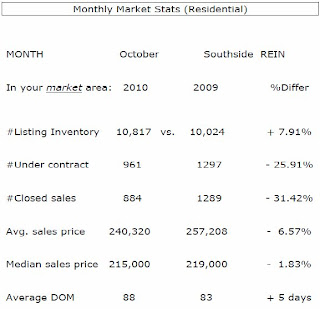
REIN reports
Effects of ’09 Tax Credit Starting to Show
(Virginia Beach, Virginia – November 8, 2010)
The effects from the residential sales surge experienced in the third and fourth quarters of 2009 are now starting to be more prominent in 2010 sales totals comparisons. Traditionally, the third and fourth quarters are slower when compared to the second quarter of the year. But, in 2009 the third quarter had the highest sales total and the fourth quarter was almost equal to the second. This shift in buyers’ habits was due in large part to the federal tax credit. It caused many people who were potential buyers in the first and second quarters of 2010 to buy in the third and fourth quarters of 2009 prior to the original tax credit expiration of November 30. This date set a line in the sand for home buyers and the following extension allowed even more buyers to move their own purchase timelines to earlier dates thus “pulling forward” home sales activity. Many people across the country bought homes sooner than planned specifically for the tax credit and skewed many settled sales totals prior to the credit’s expiration.
The number of active homes for sale in the region last month remained high and increased by 8.95% when compared to October 2009. The recent levels of homes for sale have been the highest recorded for each month since February 2010. The region has maintained a level above 15,000 available listings for seven straight months, also the most on record. However, the median listing price of homes on the market in October 2010 declined by 9% when compared to October 2009. This drop is in line with the settling of home prices in Hampton Roads and is a potential sign of housing stability.
The number of under contract residential sales fell year-over-year by 28% in October. This statistic, often referred to as a leading market indicator, does not provide a very positive outlook for the near future. Most of the recent downturn in under contract may be attributed to the expiration of the federal tax credit, but other factors are also influencing the rapid drop in transactions including availability of credit and consumer expectations.
Residential settled sales plunged 32.4% in October when compared to the same time last year. The plummet was the largest year-over-year drop since January 2009, -35%. Each of the seven major cities in the area experienced sales declines ranging from a low of -21% in Norfolk to the high of -46% in Newport News. The median sales price for October 2010 was down 1.2% when compared to October 2009. The median price for homes sold seems to have bottomed for the region with its continued small differences as recorded each month. Some areas, including Virginia Beach, Chesapeake, and James City County, are starting to experience price appreciation with each area up 1% year-over-year.
The months’ supply of inventory held at ten months, but the absorption rate, the average number of homes sold over the past twelve months, continued to decline and is now at 1,480 homes per month.
The percentage of distressed listings, those that are bank owned or short sales, expanded to account for 22% of the active homes for sale and they comprised 31.7% of the settled sales total. October was, by far, the most prevalent month for distressed sales activity in our region since the housing bubble burst. Current market conditions and the overall economy do not show signs of a dramatic decrease in distressed listings. If these trends, both percent of active and sold listings, continue upward home prices within the region may decline as a result of the downward pressure these distressed homes have on local markets.

REIN reports
Effects of ’09 Tax Credit Starting to Show
(Virginia Beach, Virginia – November 8, 2010)
The effects from the residential sales surge experienced in the third and fourth quarters of 2009 are now starting to be more prominent in 2010 sales totals comparisons. Traditionally, the third and fourth quarters are slower when compared to the second quarter of the year. But, in 2009 the third quarter had the highest sales total and the fourth quarter was almost equal to the second. This shift in buyers’ habits was due in large part to the federal tax credit. It caused many people who were potential buyers in the first and second quarters of 2010 to buy in the third and fourth quarters of 2009 prior to the original tax credit expiration of November 30. This date set a line in the sand for home buyers and the following extension allowed even more buyers to move their own purchase timelines to earlier dates thus “pulling forward” home sales activity. Many people across the country bought homes sooner than planned specifically for the tax credit and skewed many settled sales totals prior to the credit’s expiration.
The number of active homes for sale in the region last month remained high and increased by 8.95% when compared to October 2009. The recent levels of homes for sale have been the highest recorded for each month since February 2010. The region has maintained a level above 15,000 available listings for seven straight months, also the most on record. However, the median listing price of homes on the market in October 2010 declined by 9% when compared to October 2009. This drop is in line with the settling of home prices in Hampton Roads and is a potential sign of housing stability.
The number of under contract residential sales fell year-over-year by 28% in October. This statistic, often referred to as a leading market indicator, does not provide a very positive outlook for the near future. Most of the recent downturn in under contract may be attributed to the expiration of the federal tax credit, but other factors are also influencing the rapid drop in transactions including availability of credit and consumer expectations.
Residential settled sales plunged 32.4% in October when compared to the same time last year. The plummet was the largest year-over-year drop since January 2009, -35%. Each of the seven major cities in the area experienced sales declines ranging from a low of -21% in Norfolk to the high of -46% in Newport News. The median sales price for October 2010 was down 1.2% when compared to October 2009. The median price for homes sold seems to have bottomed for the region with its continued small differences as recorded each month. Some areas, including Virginia Beach, Chesapeake, and James City County, are starting to experience price appreciation with each area up 1% year-over-year.
The months’ supply of inventory held at ten months, but the absorption rate, the average number of homes sold over the past twelve months, continued to decline and is now at 1,480 homes per month.
The percentage of distressed listings, those that are bank owned or short sales, expanded to account for 22% of the active homes for sale and they comprised 31.7% of the settled sales total. October was, by far, the most prevalent month for distressed sales activity in our region since the housing bubble burst. Current market conditions and the overall economy do not show signs of a dramatic decrease in distressed listings. If these trends, both percent of active and sold listings, continue upward home prices within the region may decline as a result of the downward pressure these distressed homes have on local markets.
Tuesday, November 2, 2010
Home Buyers and Sellers Dos an Don'ts
Be Market-Smart: Dos and Don'ts for Home Sellers and Buyers
By Dan Steward
It would be unrealistic to say that the real estate market is utterly rosy right now, but neither is it thorn-filled by any means. In fact, things are decidedly looking up: July got some good news, when the National Association of Realtors reported that pending home sales rose 5.2% from downwardly revised June levels, beating economists' expectations. This is good news for both buyers and sellers.
While challenges still exist-for instance, getting the best price when selling, or securing financing when buying-there are some once-in-a-lifetime opportunities out there, and plenty of happy results can be had for both buyers and sellers. The key for both groups is to remain flexible, adaptable and diligent. To that end, here are some dos and don'ts for today's buyers and sellers:
For Sellers:
DO'S
Be flexible. Often it's the little things that push a buyer into the "yes" zone. If the buyer goes on and on about how much they love your icemaker, throw it in. If the closing has to be pushed ahead more than you expected, try to be as flexible as possible and pack the moving van a little quicker.
Clean up. One person's prize doll collection is another person's cluttered nightmare. Similarly, a living room filled with Beanie Babies could elicit a reaction of fear, rather than "Aw, how cute!" from a buyer. Put away any personal collections that not only cause clutter, but also make it hard for a buyer to see the home as his or hers, rather than yours.
DON'TS
Don't be greedy. The market-not your emotions-dictates your home's price. If comparables in the area, and several trusted real estate agents tell you your home is worth $400,000, you're not fooling anyone by pricing it at $500,000-and you're only doing yourself a disservice. Pricing it at market, even a little below, could generate a bidding war, and ultimately get you more money.
Don't get personal. If you're selling your house for a certain amount, and someone offers something much lower, don't take this as a personal affront and refuse to counteroffer. Letting your emotions get in the way can potentially ruin the deal. What's the harm in making a counteroffer?
Don't procrastinate. In the current climate, you might be scared to try to sell your home, as you may have to face a lower selling price than you may have gotten before the recession. But remember, the house you buy might be even lower, commensurately. It's all relative. So if you're serious about selling, consider doing it now. Also, acting before the cold months come is a good idea, as the winter months are historically harder for home sales.
For Buyers:
DO'S
Get a home inspection. It's important to hire a trusted home inspector to check out the house's potential issues and problems. Don't skip a home inspection because you're afraid of what you might hear-many issues sound more serious than they actually are, and can be fixed easily. And if something deal-breakingly serious is turned up, as disappointing as that is, it can save years of heartache and financial outlay. Better to walk away from a clunker.
List your place before you look for another. If you're truly serious about looking for a home, list your place first. In the current economy, banks want to make sales as uncomplicated as possible-and contingency sales, which can be very complicated, are often rejected.
Talk before you act. Don't ever start a home search without a firm budget not only in mind, but literally written down. Mutually agree with yourself-or with your partner, if you're buying with someone else-long before you start seriously searching. Going out of that zone because of a place you just "gotta have," or are emotional about, could put you in dire financial straits later. You don't want to buy a house that isn't affordable for you, and then be worried about paying for dinner and a movie on Saturday night.
DON'TS
Don't be a design snob. If someone's enormous bathroom has wallpaper border containing frolicking kittens and pastel flowers, or a wall that's a nuclear shade of green, we understand this can send you into style shock. But stand fast and ignore bad d?cor. Instead, try to envision the space raw. Besides, you can always redecorate once the home is yours.
Don't make a silly offer. There's nothing wrong with making an offer below asking price-it's no secret that today, many homes are selling for under the asking price. But going 40% below the asking price may anger the seller. Some sellers, especially more emotional ones, won't even bother counter offering an outrageously low offer. Feel free to make a deal-just don't make an offer so low that you'll be kicked off the table.
By Dan Steward
It would be unrealistic to say that the real estate market is utterly rosy right now, but neither is it thorn-filled by any means. In fact, things are decidedly looking up: July got some good news, when the National Association of Realtors reported that pending home sales rose 5.2% from downwardly revised June levels, beating economists' expectations. This is good news for both buyers and sellers.
While challenges still exist-for instance, getting the best price when selling, or securing financing when buying-there are some once-in-a-lifetime opportunities out there, and plenty of happy results can be had for both buyers and sellers. The key for both groups is to remain flexible, adaptable and diligent. To that end, here are some dos and don'ts for today's buyers and sellers:
For Sellers:
DO'S
Be flexible. Often it's the little things that push a buyer into the "yes" zone. If the buyer goes on and on about how much they love your icemaker, throw it in. If the closing has to be pushed ahead more than you expected, try to be as flexible as possible and pack the moving van a little quicker.
Clean up. One person's prize doll collection is another person's cluttered nightmare. Similarly, a living room filled with Beanie Babies could elicit a reaction of fear, rather than "Aw, how cute!" from a buyer. Put away any personal collections that not only cause clutter, but also make it hard for a buyer to see the home as his or hers, rather than yours.
DON'TS
Don't be greedy. The market-not your emotions-dictates your home's price. If comparables in the area, and several trusted real estate agents tell you your home is worth $400,000, you're not fooling anyone by pricing it at $500,000-and you're only doing yourself a disservice. Pricing it at market, even a little below, could generate a bidding war, and ultimately get you more money.
Don't get personal. If you're selling your house for a certain amount, and someone offers something much lower, don't take this as a personal affront and refuse to counteroffer. Letting your emotions get in the way can potentially ruin the deal. What's the harm in making a counteroffer?
Don't procrastinate. In the current climate, you might be scared to try to sell your home, as you may have to face a lower selling price than you may have gotten before the recession. But remember, the house you buy might be even lower, commensurately. It's all relative. So if you're serious about selling, consider doing it now. Also, acting before the cold months come is a good idea, as the winter months are historically harder for home sales.
For Buyers:
DO'S
Get a home inspection. It's important to hire a trusted home inspector to check out the house's potential issues and problems. Don't skip a home inspection because you're afraid of what you might hear-many issues sound more serious than they actually are, and can be fixed easily. And if something deal-breakingly serious is turned up, as disappointing as that is, it can save years of heartache and financial outlay. Better to walk away from a clunker.
List your place before you look for another. If you're truly serious about looking for a home, list your place first. In the current economy, banks want to make sales as uncomplicated as possible-and contingency sales, which can be very complicated, are often rejected.
Talk before you act. Don't ever start a home search without a firm budget not only in mind, but literally written down. Mutually agree with yourself-or with your partner, if you're buying with someone else-long before you start seriously searching. Going out of that zone because of a place you just "gotta have," or are emotional about, could put you in dire financial straits later. You don't want to buy a house that isn't affordable for you, and then be worried about paying for dinner and a movie on Saturday night.
DON'TS
Don't be a design snob. If someone's enormous bathroom has wallpaper border containing frolicking kittens and pastel flowers, or a wall that's a nuclear shade of green, we understand this can send you into style shock. But stand fast and ignore bad d?cor. Instead, try to envision the space raw. Besides, you can always redecorate once the home is yours.
Don't make a silly offer. There's nothing wrong with making an offer below asking price-it's no secret that today, many homes are selling for under the asking price. But going 40% below the asking price may anger the seller. Some sellers, especially more emotional ones, won't even bother counter offering an outrageously low offer. Feel free to make a deal-just don't make an offer so low that you'll be kicked off the table.
First Time Buyer Tips
RISMEDIA, May 25, 2010—Those who missed taking advantage of the first-time buyer tax credit but who are still planning the purchase of their first home, continue to have a wealth of opportunities in today’s marketplace. A few smart steps can save first-time buyers thousands of dollars. Here is a look at some of the ways how:
1. Don’t buy if you don’t plan to stayIf you can’t commit to remaining in one place for at least a few years, then owning is probably not for you, at least not yet. With the transaction costs of buying and selling a home, you may end up losing money if you sell any sooner – even in a rising market. When prices are falling, it’s an even worse proposition.
2. Start by shoring up your creditSince you probably will need to get a mortgage to buy a house, you must make sure your credit history is as clean as possible. A few months before you start house hunting, get copies of your credit report. Make sure the facts are correct, and fix any problems you discover.
3. Choose carefully between points and rateWhen picking a mortgage, you usually have the option of paying additional points- a portion of the interest that you pay at closing- in exchange for a lower interest rate. If you stay in the house for a long time- say three to five years or more- it’s usually a better deal to take the points. The lower interest rate will save you more in the long run.
4. Hire a home inspectorA home inspector can let you know if you’re about to buy a lemon of a house or warn you about potential problems. At best, you can move into the house confident that it’s in good shape; at worst, the inspector’s report can let you back out of the deal if the house has major, unexpected problems. Most typically, the home inspection can allow you to negotiate the home price to account for necessary repairs.
5. Get professional helpEven though the Internet gives buyers unprecedented access to home listings, most new buyers (and many more experienced ones) are better off using a professional agent. Look for an exclusive buyer agent, if possible, who will have your interests at heart and can help you with strategies during the bidding process.
6. Bonus Tip: Be patientBuying a home is one of the largest purchases most people will make in their lifetime. The key to avoiding buyer’s remorse is to be completely comfortable before signing on the dotted line.
Dan Steward is president, Pillar To Post.

1. Don’t buy if you don’t plan to stayIf you can’t commit to remaining in one place for at least a few years, then owning is probably not for you, at least not yet. With the transaction costs of buying and selling a home, you may end up losing money if you sell any sooner – even in a rising market. When prices are falling, it’s an even worse proposition.
2. Start by shoring up your creditSince you probably will need to get a mortgage to buy a house, you must make sure your credit history is as clean as possible. A few months before you start house hunting, get copies of your credit report. Make sure the facts are correct, and fix any problems you discover.
3. Choose carefully between points and rateWhen picking a mortgage, you usually have the option of paying additional points- a portion of the interest that you pay at closing- in exchange for a lower interest rate. If you stay in the house for a long time- say three to five years or more- it’s usually a better deal to take the points. The lower interest rate will save you more in the long run.
4. Hire a home inspectorA home inspector can let you know if you’re about to buy a lemon of a house or warn you about potential problems. At best, you can move into the house confident that it’s in good shape; at worst, the inspector’s report can let you back out of the deal if the house has major, unexpected problems. Most typically, the home inspection can allow you to negotiate the home price to account for necessary repairs.
5. Get professional helpEven though the Internet gives buyers unprecedented access to home listings, most new buyers (and many more experienced ones) are better off using a professional agent. Look for an exclusive buyer agent, if possible, who will have your interests at heart and can help you with strategies during the bidding process.
6. Bonus Tip: Be patientBuying a home is one of the largest purchases most people will make in their lifetime. The key to avoiding buyer’s remorse is to be completely comfortable before signing on the dotted line.
Dan Steward is president, Pillar To Post.
Risk Declines In Owning A Home
According to award winning Blanche Evans, real estate expert:
Home prices are up, foreclosures are down, and the demand for mortgage loans is up - all trends that collectively signal that owning a home is not as risky as it’s been in recent years.
A new report by Clear Capital, an asset valuation data services provider, has found that housing prices in Q2 2010 rose 7.9% over the first quarter, and that sales momentum continued through June, taking only the slightest breather.
Year over year, prices were up 8.1% for the quarter. Among the reasons is a drop in bank-owned properties, to 22.l7%, which is 19.8% below the peak set in Q1 2009. Prices are 13.6% on steady growth since reaching a trough, also in Q1 2009, according to Dr. Alex Villacorta, senior statistician for Clear Capital.
By August, mortgage interest rates are at an all-time low. Benchmark 30-year, fixed-rates fell to the lowest levels since 1971, at 4.44%, spurring demand for refinancing as well as purchase loans. The Mortgage Bankers Association says that demand steadily increased through mid-August on record low rates. A year ago, interest rates were 5.17%.
Adding to the good news was the Commerce Department, which announced 1.7% more construction on home in July 2010 than the previous month.
The National Association of REALTORS® (NAR) also noted an increase of 1.5% in pending home sales, suggesting that demand for housing is growing again.
Following the expiration of the homebuyer tax credit which hurried sales forward for hurry-up buyers, both new home and existing home sales declined, prompting speculation that home prices would take a double dip from the last decline in 2009. In Q2 2010, the NAR found that 100 out of 155 metropolitan statistical areas reported higher median existing single-family home prices, including 14 with a double-digit increase.
Among the reasons for the improvement was fewer distressed homes were sold, only 32% of Q2 sales from 36% the year before.
Explains Lawrence Yun, chief economist for the NAR, “The recorded home prices in many markets were significantly depressed last year because of a large percentage of distressed homes sold at discount. Now as more normal, non-distressed home sales are occurring, the median price in many areas is showing higher values.”
In August 2010, the PMI Group, Inc., reflected the collective sigh of relief with a lower U.S. Market Risk Index. Using Q1 2010 data, the mortgage risk insurer noted that its index dropped to 51.9 from 53.8 for a third consecutive quarterly decrease.
Of the nation’s metropolitan statistical areas, 290 or 75.5% are pose less risk for housing than the previous quarter. That said, more than half, or 51.6% are still in PMI’s high-risk category, with higher unemployment rates, higher foreclosure rates, lower affordability, a larger excess housing supply, or more volatile housing prices than other MSAs with minimal to moderate risks.
But as other economists have found, there is a slow but steady improvement in economic indicators including home price appreciation, mortgage market affordability, employment, housing affordability returning to median norms, and lower foreclosure activity.
"Household formation is the most important demographic driver of housing demand and faster growth, as has occurred over the period since the middle of 2009,” explains David Berson, PMI chief economist, “corresponding to a pickup in the economy, should lead to greater market stability. "Ultimately greater stability of house prices will lead to declines in the Risk Index."
Home prices are up, foreclosures are down, and the demand for mortgage loans is up - all trends that collectively signal that owning a home is not as risky as it’s been in recent years.
A new report by Clear Capital, an asset valuation data services provider, has found that housing prices in Q2 2010 rose 7.9% over the first quarter, and that sales momentum continued through June, taking only the slightest breather.
Year over year, prices were up 8.1% for the quarter. Among the reasons is a drop in bank-owned properties, to 22.l7%, which is 19.8% below the peak set in Q1 2009. Prices are 13.6% on steady growth since reaching a trough, also in Q1 2009, according to Dr. Alex Villacorta, senior statistician for Clear Capital.
By August, mortgage interest rates are at an all-time low. Benchmark 30-year, fixed-rates fell to the lowest levels since 1971, at 4.44%, spurring demand for refinancing as well as purchase loans. The Mortgage Bankers Association says that demand steadily increased through mid-August on record low rates. A year ago, interest rates were 5.17%.
Adding to the good news was the Commerce Department, which announced 1.7% more construction on home in July 2010 than the previous month.
The National Association of REALTORS® (NAR) also noted an increase of 1.5% in pending home sales, suggesting that demand for housing is growing again.
Following the expiration of the homebuyer tax credit which hurried sales forward for hurry-up buyers, both new home and existing home sales declined, prompting speculation that home prices would take a double dip from the last decline in 2009. In Q2 2010, the NAR found that 100 out of 155 metropolitan statistical areas reported higher median existing single-family home prices, including 14 with a double-digit increase.
Among the reasons for the improvement was fewer distressed homes were sold, only 32% of Q2 sales from 36% the year before.
Explains Lawrence Yun, chief economist for the NAR, “The recorded home prices in many markets were significantly depressed last year because of a large percentage of distressed homes sold at discount. Now as more normal, non-distressed home sales are occurring, the median price in many areas is showing higher values.”
In August 2010, the PMI Group, Inc., reflected the collective sigh of relief with a lower U.S. Market Risk Index. Using Q1 2010 data, the mortgage risk insurer noted that its index dropped to 51.9 from 53.8 for a third consecutive quarterly decrease.
Of the nation’s metropolitan statistical areas, 290 or 75.5% are pose less risk for housing than the previous quarter. That said, more than half, or 51.6% are still in PMI’s high-risk category, with higher unemployment rates, higher foreclosure rates, lower affordability, a larger excess housing supply, or more volatile housing prices than other MSAs with minimal to moderate risks.
But as other economists have found, there is a slow but steady improvement in economic indicators including home price appreciation, mortgage market affordability, employment, housing affordability returning to median norms, and lower foreclosure activity.
"Household formation is the most important demographic driver of housing demand and faster growth, as has occurred over the period since the middle of 2009,” explains David Berson, PMI chief economist, “corresponding to a pickup in the economy, should lead to greater market stability. "Ultimately greater stability of house prices will lead to declines in the Risk Index."
Wednesday, October 27, 2010
International Buyers Investing in U.S. Housing Market
International Buyers of Real Estate on the Rise
October 20, 2010
Thanks to the low prices that can be found on real estate throughout the United States, many foreign investors are turning their attention away from the U.S. stock market and putting their attention on the housing market instead. In fact, foreign investment in U.S. real estate has virtually skyrocketed recently, with most planning to rent out the properties and then to sell them once the economy turns around.
Given the prices that real estate investors have before them, it is easy to see why the interest has grown. At the Viceroy condos in downtown Miami, for example, units once sold for as high as $670 per square foot. Today, they can be purchased at an average price of $319 per square foot.
“I have never seen such a high concentration of foreign nationals acquiring real estate,” said Peter Zalewski in a recent Yahoo finance article. “Eight percent of the sales in downtown Miami are foreign-based. This is unprecendented.”
Miami isn’t the only market to see an increase in foreign investors, however, as other hot spots have included New York, Washington, Las Vegas, San Francisco, Los Angeles, Seattle and Phoenix. In fact, Phoenix saw more buyers from Canada than from California for the first time recently.
“It’s a positive in a sea of negatives,” said Jonathan Miller, who is the chief executive of Miller Samuel, which is a New York-based real estate consulting firm.
Even better for those with money to invest, the payoff can start immediately. Some, for example, focus solely on purchasing those condos that already have renters. In this way, he is able to immediately walk away each month with a profit after paying association fees and taxes. In short, the weak currency, high unemployment and expansive inventory have made the United States an attractive buyer’s market.
“Never before have all these things come together like this,” said Patrick O’Neill, who is the chief executive officer of the O’Neill Group in Hong Kong. “Unless you want to go to Baghdad, the United States is the best you can get.”
The National Association of Realtors is also reporting an increase in international sales, as 28% of brokers have reported working with at least one international client. This figure is up by 5% when compared to last year. Similarly, 8% of brokers report completing at least one sale with an international client, which is up from 12% in 2009.
“I was going [to] invest in the stock market, but I decided to invest in real estate instead,” said Diego Garcia, who is a native of Mexico City and is on assignment with Pfizer Inc. in New York City.
Of course, there are still risks involved with making this type of purchase, as the housing market is still far from reaching a full recovery. Furthermore, prices are still continuing to fall in many markets, which means a foreign investor could get stuck in a bad situation if needing to make a quick sale. Similarly, if a renter leaves, the investor will be stuck without any cash coming in. Nonetheless, demand from foreign investors continues to grow. In fact, overseas buyers now represent 7% of the total buyer’s market. In response, many U.S. brokerages are now hiring agents who are able to speak foreign languages.
“The international buyer pool is better than we have ever seen it before,” said Phillip White, who is the president of New York-based Sotheby’s International.
October 20, 2010
Thanks to the low prices that can be found on real estate throughout the United States, many foreign investors are turning their attention away from the U.S. stock market and putting their attention on the housing market instead. In fact, foreign investment in U.S. real estate has virtually skyrocketed recently, with most planning to rent out the properties and then to sell them once the economy turns around.
Given the prices that real estate investors have before them, it is easy to see why the interest has grown. At the Viceroy condos in downtown Miami, for example, units once sold for as high as $670 per square foot. Today, they can be purchased at an average price of $319 per square foot.
“I have never seen such a high concentration of foreign nationals acquiring real estate,” said Peter Zalewski in a recent Yahoo finance article. “Eight percent of the sales in downtown Miami are foreign-based. This is unprecendented.”
Miami isn’t the only market to see an increase in foreign investors, however, as other hot spots have included New York, Washington, Las Vegas, San Francisco, Los Angeles, Seattle and Phoenix. In fact, Phoenix saw more buyers from Canada than from California for the first time recently.
“It’s a positive in a sea of negatives,” said Jonathan Miller, who is the chief executive of Miller Samuel, which is a New York-based real estate consulting firm.
Even better for those with money to invest, the payoff can start immediately. Some, for example, focus solely on purchasing those condos that already have renters. In this way, he is able to immediately walk away each month with a profit after paying association fees and taxes. In short, the weak currency, high unemployment and expansive inventory have made the United States an attractive buyer’s market.
“Never before have all these things come together like this,” said Patrick O’Neill, who is the chief executive officer of the O’Neill Group in Hong Kong. “Unless you want to go to Baghdad, the United States is the best you can get.”
The National Association of Realtors is also reporting an increase in international sales, as 28% of brokers have reported working with at least one international client. This figure is up by 5% when compared to last year. Similarly, 8% of brokers report completing at least one sale with an international client, which is up from 12% in 2009.
“I was going [to] invest in the stock market, but I decided to invest in real estate instead,” said Diego Garcia, who is a native of Mexico City and is on assignment with Pfizer Inc. in New York City.
Of course, there are still risks involved with making this type of purchase, as the housing market is still far from reaching a full recovery. Furthermore, prices are still continuing to fall in many markets, which means a foreign investor could get stuck in a bad situation if needing to make a quick sale. Similarly, if a renter leaves, the investor will be stuck without any cash coming in. Nonetheless, demand from foreign investors continues to grow. In fact, overseas buyers now represent 7% of the total buyer’s market. In response, many U.S. brokerages are now hiring agents who are able to speak foreign languages.
“The international buyer pool is better than we have ever seen it before,” said Phillip White, who is the president of New York-based Sotheby’s International.
Monday, October 25, 2010
Don't be Scared to Buy a Home

Buying a Home Shouldn’t Be Scary
by Nancy Chandler Associates, REALTORS on Tuesday, October 12, 2010 at 3:47pm
As Halloween approaches, you might wonder if this is a good time to consider buying a home in Virginia Beach. Will you be spooked by housing costs and condo fees and real estate jargon that turns you white as a ghost because you don’t understand it. Trust us when we say that bidding on a home for sale needn’t be scary – with the right Realtor to show you all the best “haunts” suited to your family and lifestyle, you can still find a terrific deal for your needs and budget.
One plus to house hunting in October is this gorgeous Fall weather we’re currently enjoying. Here you’ll truly see neighborhoods at their most active. You’ll get a feel for various dynamics – kids at play, weekend warriors tackling their landscapes – and traffic low in the off-season. Especially if you have children, you’ll want to pay attention to school districts and opportunities for extracurricular fun, like proximity to the beach and aquarium and other favorite family spots. Some neighborhood associations may sponsor seasonal gatherings or block-wide yard sales as a sign of solid community. As real estate professionals who know the Norfolk/Virginia Beach areas, we are more than aptly qualified to match the community to your needs.
This year, as you prepare for Halloween and get your kids’ costumes ready, why not do some trick or treating of your own and check out our available listings for homes in Norfolk and Virginia Beach. What we have to offer will definitely keep you cozy through all the holidays.
Sunday, October 17, 2010
Hampton Roads Real Estate..Have we finally hit bottom??
Tuesday, October 12, 2010 — Though economists have marked many milestones as the alleged bottom of the housing market, according to Beacon researchers, current home affordability is pointing to the worst being behind us.
Beacon Economics analyzed home affordability and came away feeling optimistic.Beacon Economics founding principal Christopher Thornberg, whose firm advises a variety of business clients, says the high level of affordability is likely to drive demand and reduce the stock of excess inventory, ultimately resulting in the need for new housing, a rise in prices, and a pickup in new construction."While prices may fluctuate modestly over the next several months, we believe the worst of the housing crisis is behind us," says Beacon Economics Research Manager Jordan G. Levine. "We expect prices to stabilize around current levels and likely be higher in the next 12 months." It's a great time to buy..interest rates are at an all time low and housing prices have bottomed out!! I can help you with all of your real estate needs!
Beacon Economics analyzed home affordability and came away feeling optimistic.Beacon Economics founding principal Christopher Thornberg, whose firm advises a variety of business clients, says the high level of affordability is likely to drive demand and reduce the stock of excess inventory, ultimately resulting in the need for new housing, a rise in prices, and a pickup in new construction."While prices may fluctuate modestly over the next several months, we believe the worst of the housing crisis is behind us," says Beacon Economics Research Manager Jordan G. Levine. "We expect prices to stabilize around current levels and likely be higher in the next 12 months." It's a great time to buy..interest rates are at an all time low and housing prices have bottomed out!! I can help you with all of your real estate needs!
Subscribe to:
Posts (Atom)