
It's a great time to buy a house. Interest rates are still incredibly low and available homes are abundant. Personally, I can see the market is improving and business has really picked up. What great news!
A lender sent this article to me today and thought I'd share.
Homeownership Makes $ense
Bring on the buyers! At last, the housing market is beginning to make sense again. The ownership line is finally crossing over the rental line on the great Homeownership graph.
It is now more expensive to rent than to buy a home in 72% of major metropolitan areas across the US, according to the Trulia Rent vs. Buy Index released Monday.
This is due to rising demand for rentals and falling home prices combined with low interest rates.
Pete Flint, chief executive and co-founder of Trulia says: "Since the start of the Great Recession, many former homeowners have flooded the rental market… Following the principles of supply and demand, renting has become relatively more expensive than buying in most markets."
The index compared the median list price and rent paid for a two-bedroom home in 50 cities. It then assigned a price-to-rent ration to each city with 15 signifying a buyer's market and 21 or more signifying a renter's market. The space between the two numbers signifies a balanced market.
The cost to rent includes rent and insurance. The cost of ownership includes mortgage principal and interest, closing costs, property taxes, hazard insurance and any homeowner association dues.
Not surprising, the most affordable markets are Las Vegas and Miami where the price-to-rent ration is 6 and where the foreclosure rates have topped the charts. Las Vegas was atop the foreclosures list in Q3 with one in every 25 homes was in foreclosure.
The index reported that homeownership was cheaper in the metro areas of San Francisco, Seattle, New York and Kansas City, MO, all of whom had price-to-rent ratios over 21.
Other metros like Oakland, Sacramento, Los Angeles, Miami and Phoenix are experiencing elevated rates of unemployment or foreclosures and close economic centers with projected job growth are still more affordable to renters.
This is truly great news for the Housing Industry.
Monday, January 31, 2011

Monday, January 10, 2011
Foreclosure and Short Sale Consequences
Foreclosure is an extreme measure when an owner is "upside down" on their mortgage. It should be the last resort when you are unable to make your mortgage payments as the consequences can stick with you for many years. This is a wonderful article describing foreclosure and short sales.
Consequences of Defaults and Foreclosures
by Carla Hill
The economy has put a strain on thousands of households across the nation. In these tough times, many homeowners are struggling in the face of foreclosure. What are the consequences of defaulting on your loan? And what can you do to prevent this loss?
One of the most startling impacts of a foreclosure appears on one's credit report. Your credit score may plummet by 200 to 300 points. In this economic climate, where credit lending standards are already tightened, you may then find it difficult to do everything from buying a car to renting an apartment. What's worse is that the notation of foreclosure stays on your report for up to seven years.
Next, you may owe the lender money. They backed a loan on a home worth X amount. If they sell your home at foreclosure for less than that amount, you may be responsible for the difference. Many states have laws protecting you against this action, but speak with an attorney to find out for what you may be liable.
Lately, after the sudden drop in property values in certain markets, investors have been guilty of strategic defaults. This is when an investor purposely defaults on a property, because the time it will take for them to recoup their money is perceived as too great. A word to the wise: courts are now ordering deficiency judgements in some cases, where the investor must pay the lender back their losses.
There really is no winner in a foreclosure. With homeownership comes increased family stability. The loss of a home can be a trying time on all members of the family. Beyond your own family, a foreclosure can mean lowered property values for your entire neighborhood.
Avoiding default and foreclosure is not always possible. If you are not able to make your payments, be sure to be honest with your lender. They may be able to present you with an alternative. In addition, here are a few tips to get you thinking.
1. Short Sale. A short sale occurs when a borrower is unable to pay their mortgage loan. Both the homeowner and lender consent to a short sale, which means selling the home at a moderate loss, avoiding foreclosure and its associated frees and havoc on credit reports.
2. Talk to your lender. They may be able to offer you programs, refinancing, or counseling that can help you avoid losing your home. Most banks don't want you to foreclose, as it would mean they take a loss.
3. Selling if not underwater. If you are not underwater on your home loan, meaning you don't owe more than you can sell for and owe, then now is the time to employ a real estate agent and get your home sold. Downsizing or even renting is a better option than ruining your credit for the next seven years.
4. Budgeting. There are non-necessities that can be cut out of your expenses. Cut down and live as simply as possibly. You may have more money than you realized!
5. Financial counseling. Defaulting is serious business. You would be wise to meet with a financial counselor to see if they can help you avoid losing your home.
6. Refinancing or loan modification. Your bank or lender may be willing to allow you to refinance. This can translate into lower monthly payments.
The bottom line is this. Defaulting on your mortgage has severe consequences. Try your best to balance finances before your mortgage becomes an issue. And be honest and upfront with your lender in the event that a default is likely.
Published: January 6, 2011
Thursday, December 23, 2010
"Pending Sales Are Up"
Finally! On the uptrend, pending sales increased in October since bottoming in June, according to the National Association of REALTORS.
A "pending" or "under contract" sale, is a real estate sale that is non-contingent (ex: home inspection contingency removed)and is moving forward to closing.
Read more about this at
http://www.realtor.org/press_room/news_releases/2010/12/strong_phs
Happy Holidays Everyone! Have a happy, healthy and prosperous new year!
Tuesday, November 23, 2010
Holiday closings in South Hampton Roads
I'd like to wish everyone a wonderful Thanksgiving!
http://hamptonroads.com/2010/11/holiday-closings-south-hampton-roads?cid=srch
http://hamptonroads.com/2010/11/holiday-closings-south-hampton-roads?cid=srch
Sunday, November 21, 2010
Tax Credit Effects on the Real Estate Market
Last year's tax credit encouraged many buyers that were "sitting on the fence" to go ahead and purchase a new home. Here are the market stats for the month of October as it compares to this time last year.
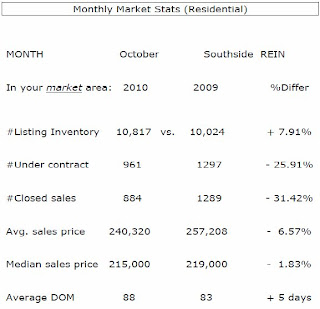
REIN reports
Effects of ’09 Tax Credit Starting to Show
(Virginia Beach, Virginia – November 8, 2010)
The effects from the residential sales surge experienced in the third and fourth quarters of 2009 are now starting to be more prominent in 2010 sales totals comparisons. Traditionally, the third and fourth quarters are slower when compared to the second quarter of the year. But, in 2009 the third quarter had the highest sales total and the fourth quarter was almost equal to the second. This shift in buyers’ habits was due in large part to the federal tax credit. It caused many people who were potential buyers in the first and second quarters of 2010 to buy in the third and fourth quarters of 2009 prior to the original tax credit expiration of November 30. This date set a line in the sand for home buyers and the following extension allowed even more buyers to move their own purchase timelines to earlier dates thus “pulling forward” home sales activity. Many people across the country bought homes sooner than planned specifically for the tax credit and skewed many settled sales totals prior to the credit’s expiration.
The number of active homes for sale in the region last month remained high and increased by 8.95% when compared to October 2009. The recent levels of homes for sale have been the highest recorded for each month since February 2010. The region has maintained a level above 15,000 available listings for seven straight months, also the most on record. However, the median listing price of homes on the market in October 2010 declined by 9% when compared to October 2009. This drop is in line with the settling of home prices in Hampton Roads and is a potential sign of housing stability.
The number of under contract residential sales fell year-over-year by 28% in October. This statistic, often referred to as a leading market indicator, does not provide a very positive outlook for the near future. Most of the recent downturn in under contract may be attributed to the expiration of the federal tax credit, but other factors are also influencing the rapid drop in transactions including availability of credit and consumer expectations.
Residential settled sales plunged 32.4% in October when compared to the same time last year. The plummet was the largest year-over-year drop since January 2009, -35%. Each of the seven major cities in the area experienced sales declines ranging from a low of -21% in Norfolk to the high of -46% in Newport News. The median sales price for October 2010 was down 1.2% when compared to October 2009. The median price for homes sold seems to have bottomed for the region with its continued small differences as recorded each month. Some areas, including Virginia Beach, Chesapeake, and James City County, are starting to experience price appreciation with each area up 1% year-over-year.
The months’ supply of inventory held at ten months, but the absorption rate, the average number of homes sold over the past twelve months, continued to decline and is now at 1,480 homes per month.
The percentage of distressed listings, those that are bank owned or short sales, expanded to account for 22% of the active homes for sale and they comprised 31.7% of the settled sales total. October was, by far, the most prevalent month for distressed sales activity in our region since the housing bubble burst. Current market conditions and the overall economy do not show signs of a dramatic decrease in distressed listings. If these trends, both percent of active and sold listings, continue upward home prices within the region may decline as a result of the downward pressure these distressed homes have on local markets.
Tuesday, November 2, 2010
Home Buyers and Sellers Dos an Don'ts
Be Market-Smart: Dos and Don'ts for Home Sellers and Buyers
By Dan Steward
It would be unrealistic to say that the real estate market is utterly rosy right now, but neither is it thorn-filled by any means. In fact, things are decidedly looking up: July got some good news, when the National Association of Realtors reported that pending home sales rose 5.2% from downwardly revised June levels, beating economists' expectations. This is good news for both buyers and sellers.
While challenges still exist-for instance, getting the best price when selling, or securing financing when buying-there are some once-in-a-lifetime opportunities out there, and plenty of happy results can be had for both buyers and sellers. The key for both groups is to remain flexible, adaptable and diligent. To that end, here are some dos and don'ts for today's buyers and sellers:
For Sellers:
DO'S
Be flexible. Often it's the little things that push a buyer into the "yes" zone. If the buyer goes on and on about how much they love your icemaker, throw it in. If the closing has to be pushed ahead more than you expected, try to be as flexible as possible and pack the moving van a little quicker.
Clean up. One person's prize doll collection is another person's cluttered nightmare. Similarly, a living room filled with Beanie Babies could elicit a reaction of fear, rather than "Aw, how cute!" from a buyer. Put away any personal collections that not only cause clutter, but also make it hard for a buyer to see the home as his or hers, rather than yours.
DON'TS
Don't be greedy. The market-not your emotions-dictates your home's price. If comparables in the area, and several trusted real estate agents tell you your home is worth $400,000, you're not fooling anyone by pricing it at $500,000-and you're only doing yourself a disservice. Pricing it at market, even a little below, could generate a bidding war, and ultimately get you more money.
Don't get personal. If you're selling your house for a certain amount, and someone offers something much lower, don't take this as a personal affront and refuse to counteroffer. Letting your emotions get in the way can potentially ruin the deal. What's the harm in making a counteroffer?
Don't procrastinate. In the current climate, you might be scared to try to sell your home, as you may have to face a lower selling price than you may have gotten before the recession. But remember, the house you buy might be even lower, commensurately. It's all relative. So if you're serious about selling, consider doing it now. Also, acting before the cold months come is a good idea, as the winter months are historically harder for home sales.
For Buyers:
DO'S
Get a home inspection. It's important to hire a trusted home inspector to check out the house's potential issues and problems. Don't skip a home inspection because you're afraid of what you might hear-many issues sound more serious than they actually are, and can be fixed easily. And if something deal-breakingly serious is turned up, as disappointing as that is, it can save years of heartache and financial outlay. Better to walk away from a clunker.
List your place before you look for another. If you're truly serious about looking for a home, list your place first. In the current economy, banks want to make sales as uncomplicated as possible-and contingency sales, which can be very complicated, are often rejected.
Talk before you act. Don't ever start a home search without a firm budget not only in mind, but literally written down. Mutually agree with yourself-or with your partner, if you're buying with someone else-long before you start seriously searching. Going out of that zone because of a place you just "gotta have," or are emotional about, could put you in dire financial straits later. You don't want to buy a house that isn't affordable for you, and then be worried about paying for dinner and a movie on Saturday night.
DON'TS
Don't be a design snob. If someone's enormous bathroom has wallpaper border containing frolicking kittens and pastel flowers, or a wall that's a nuclear shade of green, we understand this can send you into style shock. But stand fast and ignore bad d?cor. Instead, try to envision the space raw. Besides, you can always redecorate once the home is yours.
Don't make a silly offer. There's nothing wrong with making an offer below asking price-it's no secret that today, many homes are selling for under the asking price. But going 40% below the asking price may anger the seller. Some sellers, especially more emotional ones, won't even bother counter offering an outrageously low offer. Feel free to make a deal-just don't make an offer so low that you'll be kicked off the table.
First Time Buyer Tips
RISMEDIA, May 25, 2010—Those who missed taking advantage of the first-time buyer tax credit but who are still planning the purchase of their first home, continue to have a wealth of opportunities in today’s marketplace. A few smart steps can save first-time buyers thousands of dollars. Here is a look at some of the ways how:
1. Don’t buy if you don’t plan to stayIf you can’t commit to remaining in one place for at least a few years, then owning is probably not for you, at least not yet. With the transaction costs of buying and selling a home, you may end up losing money if you sell any sooner – even in a rising market. When prices are falling, it’s an even worse proposition.
2. Start by shoring up your creditSince you probably will need to get a mortgage to buy a house, you must make sure your credit history is as clean as possible. A few months before you start house hunting, get copies of your credit report. Make sure the facts are correct, and fix any problems you discover.
3. Choose carefully between points and rateWhen picking a mortgage, you usually have the option of paying additional points- a portion of the interest that you pay at closing- in exchange for a lower interest rate. If you stay in the house for a long time- say three to five years or more- it’s usually a better deal to take the points. The lower interest rate will save you more in the long run.
4. Hire a home inspectorA home inspector can let you know if you’re about to buy a lemon of a house or warn you about potential problems. At best, you can move into the house confident that it’s in good shape; at worst, the inspector’s report can let you back out of the deal if the house has major, unexpected problems. Most typically, the home inspection can allow you to negotiate the home price to account for necessary repairs.
5. Get professional helpEven though the Internet gives buyers unprecedented access to home listings, most new buyers (and many more experienced ones) are better off using a professional agent. Look for an exclusive buyer agent, if possible, who will have your interests at heart and can help you with strategies during the bidding process.
6. Bonus Tip: Be patientBuying a home is one of the largest purchases most people will make in their lifetime. The key to avoiding buyer’s remorse is to be completely comfortable before signing on the dotted line.
Dan Steward is president, Pillar To Post.

1. Don’t buy if you don’t plan to stayIf you can’t commit to remaining in one place for at least a few years, then owning is probably not for you, at least not yet. With the transaction costs of buying and selling a home, you may end up losing money if you sell any sooner – even in a rising market. When prices are falling, it’s an even worse proposition.
2. Start by shoring up your creditSince you probably will need to get a mortgage to buy a house, you must make sure your credit history is as clean as possible. A few months before you start house hunting, get copies of your credit report. Make sure the facts are correct, and fix any problems you discover.
3. Choose carefully between points and rateWhen picking a mortgage, you usually have the option of paying additional points- a portion of the interest that you pay at closing- in exchange for a lower interest rate. If you stay in the house for a long time- say three to five years or more- it’s usually a better deal to take the points. The lower interest rate will save you more in the long run.
4. Hire a home inspectorA home inspector can let you know if you’re about to buy a lemon of a house or warn you about potential problems. At best, you can move into the house confident that it’s in good shape; at worst, the inspector’s report can let you back out of the deal if the house has major, unexpected problems. Most typically, the home inspection can allow you to negotiate the home price to account for necessary repairs.
5. Get professional helpEven though the Internet gives buyers unprecedented access to home listings, most new buyers (and many more experienced ones) are better off using a professional agent. Look for an exclusive buyer agent, if possible, who will have your interests at heart and can help you with strategies during the bidding process.
6. Bonus Tip: Be patientBuying a home is one of the largest purchases most people will make in their lifetime. The key to avoiding buyer’s remorse is to be completely comfortable before signing on the dotted line.
Dan Steward is president, Pillar To Post.
Subscribe to:
Posts (Atom)